

Upton Cheyney
Introduction
Upton Cheyney is a small village on the southern edge of the Cotswolds, overlooking the Avon valley. Its rural character has survived remarkably well, and many of its historic buildings remain at the heart of the village. Its story, however, reaches back far beyond the surviving cottages and farmhouses: archaeological discoveries provide evidence of Neolithic and Roman occupation, while the medieval and later history of the manor shaped the village that developed here. In more recent times, the memories of former residents provide a vivid picture of village life in the 19th and 20th centuries.
By 1350, Henry le Chaun had acquired land here, and it is possible, but not certain, that “Chaun” is the origin of “Cheyney”. Upton was part of a system of “frankpledge”, in which groups of ten families were responsible for each other’s peaceable behaviour. These matters were regulated through an annual court-leet held at the Manor House (now Manor Farm). Its 16th century dovecote, a privilege of the Lord of the Manor, also survives.
A new manor house, now Upton House, was built in the early 17th century, replacing the older manor house. It was restyled during the 18th and 19th centuries, with its front part rebuilt in 1857 in the Tudor style.
The manorial rights subsequently passed to Brice Seede, whose daughter Alice married the Reverend Edward Parker. In 1701 Parker bought the Upton Estate from Arthur Lacy, including the Manor House. The Parker family remained connected with Upton for some three hundred years.
The Hawking family later acquired the estate. “Old man Hawking”, who came from Devon, was followed by his son Arthur, who developed the family’s greenhouse business. The Hawking family have continued farming here for five generations.
Upton Cheyney retained much of its rural character. By 1965 Upton had five farms, 59 houses and cottages, and a population of 155. Nearby Beach had six farms, eight houses and cottages, and 55 people, making 11 farms and 210 inhabitants altogether.

Photo 1900s; courtesy Bristol Records Office

Upton House; courtesy Historic England

Photo Manor Farm House; courtesy David Craig Historic England
Manor Farm at the junction of Wick Lane was mentioned in the Domesday Book. Most of the buildings in the village date from the early 17th century to the later 19th century.
Village Architecture
The larger houses are 17th century or earlier, and tend to have more variation in style, height and roof type, with gable dormers such as Upton Farmhouse, Chetwynds and Holisters. Upton House, which dates from the early 17th century, with many later additions, has a gabled belfry, dormers, stone-tiled roof with diagonally set chimney stacks and is particularly attractive, acting as a focal point to the village centre. The cottages, many 17th century and originally thatched, tend to be of simpler design. The non-residential buildings tend to be of a larger scale and include the Upton Inn, which was built around 1710, the United Reformed church, built in 1834, and the former school, dating from 1894.
Read more: Reminiscences-of-Upton-Cheyney by D.D.R. Norman
Upton Cheyney in Roman Times
Archaeological records indicate the site of a Roman settlement to the south-east of the village and at nearby Pipley Bottom the stepped terraces, cut by Romano-Britons for vine cultivation can still be seen. It is likely that the present settlement grew up around springs and above the marshy river valleys.
Excavations on one of Manor Farm’s fields in Upton Cheyney reveal an important Roman site. Archaeologists led by Tony Roberts of Archeoscan have uncovered what was possibly a 2nd century domestic building that has been remodelled at a later date in the Roman period as a workshop area. This houses a series of collapsed domes, originally of clay and later of stone, probably ovens. Large millstones have been found, so this may have been a milling area.
The site has yielded hairpins, medical instruments and brooches as well as a carved fragment of second century Samianware imported from central Gaul, now France, showing a gladiator with weapon raised.
Taken together, these discoveries provide evidence of a substantial and varied Roman presence in the area, rather than a simple rural settlement.
.

Photo courtesy Tony Roberts Archeoscan; 2018

Photo Upton Cheyney URC; photo courtesy Historic England
Upton Cheyney URC Chapel
The roots of nonconformist worship in Upton Cheyney go back to the 1740s when the ‘Kingswood Preachers’ were evangelising in local villages, John Cennick being the most associated with Upton Cheyney. Prior to the church being built, a worshipping community in Upton Cheyney was established at the time of the Wesleyan Revival which thrived in Kingswood and Hanham in the late 1700s. Like most of the nearby areas, local folk gathered to study the Bible in cottages with regular visits from various evangelical preachers.
Some years later, in 1794, to comply with the law an application was made to the Bishop of Gloucester for a licence to hold non-conformist public worship in the village. The services were to be held in the house of John Hopes, the same cottage in which John Cennick had preached 50 years before (this house is known as Humberstones).
The Chapel which was part of the Congregational Church was built in 1834. Then 15 years later in 1849 the Chapel’s Schoolhouse was opened. Due to declining numbers the chapel closed on the 10th September 2023.
Read more: URC-Upton-Cheyney by David Noble
Read more: upton-cheyney-urc-chapel on our website page
The Upton Inn
Historic England suggests a building has stood on the site of the Upton Inn since at least 1710, although its early history remains uncertain. Situated below Lansdown and away from the main coaching routes, it is not clearly identified as an inn until the 19th century, and early maps describe it as a Beer House rather than a Public House (beer houses could sell beer but not wine or spirits).
Clement Bush was operating a brewery at Springfield House in 1841, possibly supplying local beer sellers. The 1840 tithe map records the property (plot 1196) as owned by John Flower. In 1841, however, Henry Wathen, a 60-year-old beer seller, lived there with his family. His son John took over by 1861, combining innkeeping with agricultural work. In 1869 Mary Ann Frances Flower unsuccessfully applied for a licence.
Several landlords followed, including James Nash, Daniel H. Bath, James Stacey and Robert Marke. By 1903 the inn was owned by Bristol United Brewery and had become a tied house.
Read more: The Upton Inn by Julie Johns

1940s photo of Upton Inn courtesy of Bristol Archives Ref: 42562/Ph/1/26/71
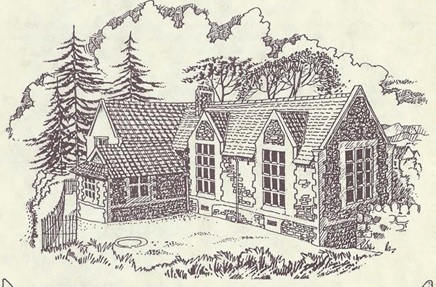

photo: Upton School class of 1966: courtesy Mrs Joyce Cooper
Upton Cheyney School
Jim Allen (1919-2016) wrote about his experience in education in the 1920s.
“Although there had been some education in Upton Cheyney before 1849 [in the URC Chapel. In 1894 it was pronounced no longer fit for purpose and a new school was built at the junction of Marshfield and Lansdown Lanes.] Most of the children came from Upton, but some from, Kelston Mills, Swineford, North Stoke and Bitton. It was threatened with closure in the 1960s but remained vibrant till 1981.
“Upton Cheyney School in the 1920s taught what are now known as the 3Rs and gave the children an unashamed patriotism and the basis of citizenship. The sandtray where we made our letters with sticks in the sand and the slates and crayons had been abandoned and pencils, exercise books, and, for the more advanced, there were pens, ink (and crossed nibs and blots!)
We had hymns and prayers daily. We learnt all three verses of God Save the King, and savoured “Confound their politics, Frustrate their knavish tricks”. We sang a Rudyard Kipling hymn with each verse ending in “Lord God of Hosts, be with us yet, Lest we forget, Lest we forget”.
Read more: Upton Cheyney School by Jim Allen
Read more: Upton-Cheyney-School on our website page
The Village Shop
Jim Allen (1919-2016) and his brother Jack wrote extensively about their childhood in Upton Cheyney. In this article Jim reminisced about what was a typical village shop in 1925.
“The shop, the converted front room of a square-faced house, had been in existence since the 1890s and was once the provider not only of groceries, but of bread and bacon. The stringcourse below the upper windows proclaimed HOME BAKED BREAD. HOME CURED BACON
“Although the bakery had ceased operating during the Great War, the shop no longer baked bread or cured bacon. Villagers nevertheless continued to use the back yard to slaughter their home-reared pigs.
“The shop came into the care of Elizabeth Mortimer in 1907 on the death of her parents, and it was she who served the early callers, winter and summer.”
Read more: Store-Upton by Jim Allen

Photo: The Village Shop (one time bakery); approx 1935; courtesy Jim Allen

The 1920s
Jim Allen wrote about his memories of Pipley Brook in the 1920s. Little has changed since then.
“The stream that skitters down the southern-most escarpment of the limestone Cotswolds from Lansdown into the lowlands of the River Avon was an idyllic playground in the 1920s.
“We never found a real source of the brook. Upstream a confluence of springs met from both sides of the valley to be piped into and contained in an iron tank where the water was forcibly pumped up to Brockham End House at the head of the valley. There was a spasmodic ‘thump thump’, and as there was no sign of any other power source, we concluded it operated hydraulically. There was enough water to escape and gather with other streamlets into a foot wide stream. It eventually escaped the woods and apart from a few soggy parts flowed into open grassland by Congrove Cottage where Jim Jenkins farmed.”
Read more: Pipley Brook-1920s by Jim Allen
Jack Allen, writing about his childhood in the village, recalled a place that had changed remarkably little over the previous century:
“Upton Cheyney must have remained totally unchanged in more than a hundred years. Electricity was supplied in the early thirties, the main sewerage more than forty years later. Impossible to railways, and inaccessible to buses, it has never been served by public transport. Although the surfaces have been smoothed and tarred, the roads have not been straightened or widened, except that sometime in the last century, an exceptionally steep part of the road up from Bitton was abandoned, and a road, not quite so steep, was built to wind around the hillside.”
Read more: My-Childhood-and-Upton-Cheyney

Upton Cheyney 1920s: photo courtesy Bristol Records Office

Photo: Charlie and Edith Jenkins, tenant farmers at Pipley Bottom; 1936; photo courtesy Judith Emrich
The Second World War
During the Second World War the Lucker family ran the general store from the converted downstairs room. Joyce Hale was lucky enough to have been invited to live with the Luckers as an evacuee.
Read more Upton-Cheyney-Evacuee. by Ian Haddrell
Judith Emrich has written of her recollections of a brief but memorable period during the Second World War, when, as a young child, she was sent from Bristol to a remote farmhouse at Pipley Bottom. Although she stayed there for only a few weeks, the experience left vivid impressions of life on a small wartime farm which were very different from her city upbringing.
Read more: Pipley-Bottom-in-the-War-Years by Judith Emrich
George Jenkins tells us of the harsh conditions during war time at a remote farm in Lansdown Lane, Upton Cheyney – No electricity or gas, no running water, let alone hot water and no flush toilet.
Read more:: George-Jenkins-Meanderings
Oral History from the 1920s: Arthur Hawking and Spencer Willliams were interviewed about school life in the 1920s. The interview was made by the pupils of Upton Cheyney School.